
Thobes and Mannequins: The Strategic Visual Playbook for Saudi Retail Leaders
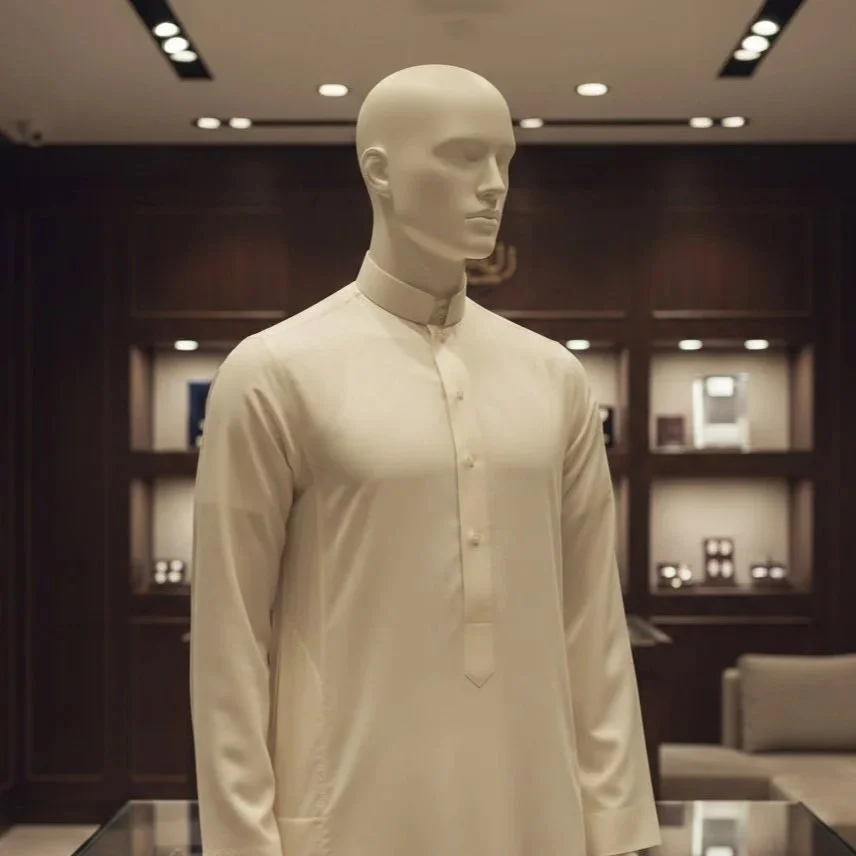
The Saudi retail landscape is shifting. As a brand owner, you know that selling a Thobe is no longer just about fabric quality or tailoring precision—it is about the presentation. In a market flooded with options, the silent salesman on your shop floor—the Mannequin—carries the weight of your brand’s reputation.
Yet, most retailers in Saudi Arabia continue to display premium Thobes on generic, ill-fitting forms that collapse the garment’s structure and cheapen its perceived value.
If you are looking to maximize ROI per square meter and elevate your brand authority, you must stop treating mannequins as furniture and start treating them as strategic assets. This guide analyzes why the standard approach fails the Thobe and how Fiberglass precision can transform your conversion rates.
The "Drape" Dilemma: Why Standard Mannequins Fail the Thobe
A Thobe is not a suit; it does not rely on shoulder pads or rigid linings to hold its shape. It relies on gravity and the body’s natural posture.
When you dress a standard, mass-market mannequin in a Thobe, two specific failures occur that kill the sale before the customer even checks the price tag:
The Shoulder Collapse: Cheap plastic mannequins often lack the anatomical shoulder definition required to let the Thobe fabric flow seamlessly. This results in bunching at the collar—a visual cue of "poor tailoring" to the customer, even if the garment is perfect.
The Static Stiffness: Thobes are garments of grace and dignity. Rigid, military-posture mannequins make the fabric look stiff and uncomfortable. To sell the lifestyle, you need mannequins that suggest subtle movement—a slight turn of the head or a confident stride.
Strategic Insight: Your customer does not buy a piece of cloth. They buy the dignity, status, and comfort that the cloth promises. If your display fails to promise this, you have lost the sale.
Material Matters: The ROI of Fiberglass in Saudi Retail
As a decision-maker, you are constantly balancing CapEx (Capital Expenditure) against OpEx (Operational Expenditure). You might be tempted to cut costs with plastic displays. Here is why that is a financial mistake in the Saudi climate.
Fiberglass is the non-negotiable standard for high-end retail in Saudi Arabia for three distinct reasons:
Heat Resistance: Retail lighting and direct window sun generate significant heat. Plastic warps, leading to leaning mannequins that ruin your store’s symmetry. Fiberglass maintains its structural integrity for years.
Fabric Friction: Plastic generates static and friction, causing the Thobe to cling unnaturally. The smooth, premium finish of a fiberglass mannequin allows the fabric to fall effortlessly, mimicking the heavy, luxurious drape of quality wool or cotton.
Longevity: A chipped mannequin tells a customer your brand is decaying. Fiberglass is resistant to the daily wear-and-tear of frequent re-merchandising.
Read more on [Top 5 Reasons Fiberglass Mannequins Are Perfect for Saudi Retailers]
The "Eye-Level" Strategy: Winning the Psychological Game
Visual merchandising is not just about making things look pretty; it is about directing the gaze.
We encourage you to implement the "Eye-Level Connection" strategy. In a Thobe retail environment, the customer’s gaze naturally falls on the chest and head area (to check the collar and embroidery details).
Elevate the Product: Ensure your mannequins are positioned on plinths if necessary, so the detailed embroidery of the Thobe meets the customer directly at eye level.
The Head Turn: Avoid mannequins that stare straight ahead into nothingness. Use models with a 15-degree head turn. This subtle dynamic pose psychologically invites the customer to look where the mannequin is looking—usually at your new arrival rack or a promotional offer.
Regional Nuance: Respecting the Modest Aesthetic
Selling in Riyadh or Jeddah requires a deep understanding of cultural nuance. A Mannequin in this region is not just a hanger; it is a representation of the modern Saudi man.
1. Abstract vs. Realistic
For traditional Thobe retailers, we recommend semi-abstract or headless styles if you wish to focus purely on the tailoring. However, for modern, youth-oriented brands, realistic features with groomed beards are becoming the trend to help the younger demographic visualize themselves in the product.
2. The Group Effect
Never display a Thobe in isolation. Use the "Rule of Three" in your visual merchandising.
Mannequin 1: Standing tall, authoritative (The Executive look).
Mannequin 2: Seated or relaxed pose (The Majlis look).
Mannequin 3: Dynamic/Walking (The Daily Lifestyle).
This tells a complete story of where and how your product can be worn, increasing the likelihood of a multi-item purchase.
Explore our guide on [Maximizing Sales with the Right Mannequin Style]
Actionable Checklist: Is Your Store Sabotaging Sales?
Before you invest in your next season’s inventory, audit your current floor.
Check for Leaning: Are your current mannequins standing perfectly straight, or has heat warped them?
Check the Shoulders: Is the Thobe bunching at the neck?
Check the Surface: Run your hand over the mannequin. Is it rough? If so, it is damaging your sample garments.
Check the Material: Is it Fiberglass? If not, you are losing money on replacement costs
Conclusion: Upgrade Your Silent Sales Force
Your brand is premium. Your tailoring is exquisite. Do not let a cheap display unit be the reason a customer walks past your store. By switching to high-quality Fiberglass mannequins designed specifically for the drape and flow of a Thobe, you are not just buying a prop—you are investing in a 24/7 sales agent that never tires.
In Saudi Arabia, where presentation is paramount, the details define the leader.
Social Proof
“Since switching our Thobe displays to AMOY’s fiberglass collection, we noticed a 30% increase in walk-ins. The garments simply look more expensive.”
